Page Contents
What is Plaque Psoriasis?
Psoriasis is a known skin condition and its most common type is plaque psoriasis. This chronic disease may come and go, that is why this skin condition is considered a great nuisance by the sufferer. Others may even feel it as disabling for it can hinder with the activities of the daily living.
It is noted that about 80% to 90% of psoriasis cases are plaque or chronic stationary psoriasis. In number, about 5 million people from the United States are suffering from plaque psoriasis. Children and adults are equally affected, as well men and women are. However, the peak occurrence of plaque psoriasis reported to be ages 16 to 22 years. Peak incidence also arises with increasing age.
According to research, plaque psoriasis is linked to the immune system. This is an inflammatory disease that results to abnormal skin differentiation. When there is a problem with the immune system, there is said to be an abnormal triggering of inflammation to the skin by the body’s T cells. These T cells tend to cause abnormal skin growth, in slow or fast rates, that pile up and result to plaques and patches. It’s also been known that a family history of psoriasis plays a great role in acquiring the disease.
How does plaque psoriasis look like?
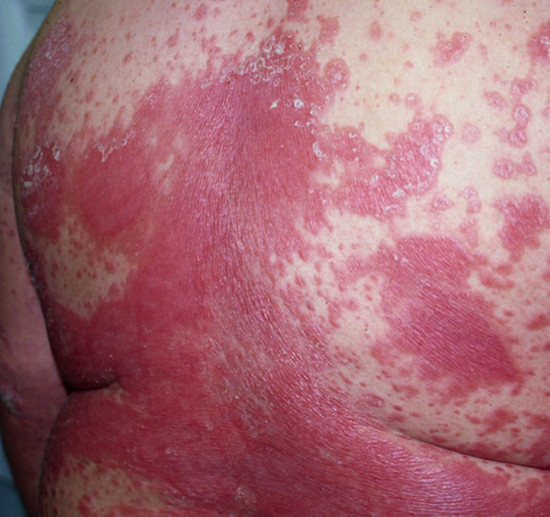
Apparently, this condition results to skin reddening, dry and raised lesions with silvery scales. The common areas of affectation are the knees, back, elbows and the scalp and usually in a form of skin patched with circular red plaques. The areas frequently affected are the knees and elbows of the patient. It may be unrecognizable in early stages, as it only appears to be small red bumps. But as it progresses, the scaling surfaces and the bumps become enlarged.
Plaque Psoriasis Pictures

Picture 1: Plaque Psoriasis
Image source : Hon Pak, MD.

Picture 2: Plaque Psoriasis on nail
Image source : wikipedia.org

Picture 3: Plaque Psoriasis of scalp (scales are not dry rather greasy looking)
Image source : Hon Pak, MD.
Picture 4: Plaque Psoriasis on the back
Image source : Hon Pak, MD.
Symptoms of Plaque Psoriasis
A person suffering from plaque psoriasis would generally manifest reddened raised lesions with scaling. They usually complain of itchiness and burning sensation. These patches are located on the scalp, elbows, lower back, and knees. Some have them on the whole trunk. Psoriasis may appear suddenly or progress gradually. It can be in acute form or long lasting, like for months. Unfortunately for the patient, there are times of remission and recurrence.
The following are the detailed manifestation of plaque psoriasis:
- Plaques. Elevated lesions surface from the skin and may vary in size. The outer layer of the skin, epidermis, is the area most affected while it can expand to the dermal vascular area where the blood vessels are located. Lesions are numerous in number while some flare-ups are limited. The basic characteristics of the plaques are its oval shape and reddened lesions. Some lesions are small in size but may enlarge as they gradually worsen.
- Redness. Patients would identify the color of plaque lesions as “salmon-colored”. It is distinct as it is in full and rich red color. If lesions are present in the lower extremities, they tend to develop into blue tints as less blood circulation comes to the area.
- Scale. The scales are dry and silvery-white in appearance. Some are thin while other lesions have thick scales. When you attempt to remove the scales, the skin under appears shiny but with areas of blood and is actually a phenomenon and an identifier; the Auspitz sign.
- Well-circumscribed margins. These margins or boundaries are somehow the mark of the plaques. The margins are like halos or rings surrounding and encircling the plaques.
- Symmetrically located. There is equal distribution of the psoriatic plaques all over the body.
- Pruritus/itch. This is considered as a main symptom of plaque psoriasis.
- Other areas of affectation. The scalp is affected with dry, scaly plaques. Nails are a common area of affectation. The nails would appear with indentations and pitting. Areas which are not usually exposed are affected with plaque psoriasis. It has been noted that the groin, buttocks, areas under the breast (for women and overweight men), and the underarm are also affected.
Plaque Psoriasis Causes
Plaque psoriasis is basically linked to an abnormal inflammatory reaction. Still, there are certain factors that precipitate the development of the skin disease. The following are considered the triggering environmental factors of plaque psoriasis:
- Trauma or injury to skin. These may include cuts, burns and even insect bites. Trauma may also be from a surgical intervention.
Sunlight/sunburn. Too much sunlight is considered to trigger development of plaques. - Infection. This includes HIV- AIDS, which is basically a common ailment that can develop psoriasis. Other forms of infection such as bacterial streptococcal infections are found to be causative of psoriasis.
- Certain medications. It has been implicated that beta-blockers, antimalarial drugs and NSAIDs can cause psoriasis. These drugs are known to exacerbate or complicate psoriasis. Some patients experience recurrence of psoriasis with lithium and from withdrawal of corticosteroids.
- Stress/anxiety/depression. This is considered to be influential in the development of immune system diseases. This may not be the cause but can worsen the current skin flare-ups.
- Smoking and alcohol consumption. These practices can weaken ones immune system making one susceptible, in general, to diseases.
Diagnosis
The condition can be easily diagnosed with a physical examination. There is no specific blood examination or procedure for psoriasis. But in order to rule out other possibilities, such as underlying skin conditions, and to confirm for plaque psoriasis a skin biopsy is ordered.
Treatment for Plaque Psoriasis
Management for plaque psoriasis is aimed in providing comfort to the client and to avoid infection. The following is the proposed treatment for plaque psoriasis:
Topical agents
This is the first-line treatment for plaque psoriasis. Unfortunately, there is no direct topical agent for plaque psoriasis. The approach in treating this condition is to face it in combination. These agents are corticosteroids, coal tar, calcipotriene and tazarotene. Other agents are also provided just to reduce the presenting symptoms, such as salicylic acid which is good for itchiness. After two to three weeks of treatment, favorable results may be observed. Less redness may be observed.
Systemic treatment
This shall target the immune system by suppressing it. These drugs shall include methotrexate and cyclosporine. New approved drugs which present good results include adalimumab, alefacept, etanercept and infliximab.
Phototherapy
This is only advisable when the condition is extensive. If there is resistance from the given topical agents and systemic agents, phototherapy is highly advised. This treatment is also done in conjunction with topical treatments to have better results.
Home care and natural treatment should not be neglected. Here are some health care tips for patients and close of kin:
- Avoid exposure to sunlight. This can help avoid exacerbation of the skin lesions and itchiness. One can ask the doctor’s advice on good sunscreen products.
- Skin care. It is necessary to keep skin moist and soft. Application of moisturizers can be helpful.
- Provide oatmeal baths to help soothe the discomfort and to loosen up the scales. Warm baths can be of help in providing comfort. Make sure that one would avoid use of irritating soaps and cosmetic materials.
- Make sure to avoid scratching the lesions for this can only worsen the state of the skin.
The treatments above can only be done if assisted by doctors. They will be the one to tell you what treatment should be done to the patient. Never try to speculate otherwise, the situation will worsen.
References
http://www.emedicinehealth.com/plaque_psoriasis/article_em.htm
http://emedicine.medscape.com/article/1108072-overview
http://en.wikipedia.org/wiki/Psoriasis
http://www.ncbi.nlm.nih.gov/pubmedhealth/PMH0001470/