

Page Contents
Lyme Disease
About the disease
Lyme disease is one of the most common tick-borne diseases in the Northern Hemisphere. This is caused by the spirochete bacteria wherein Borrelia burgdorferi is the most common bacterium. The ticks carry the bacteria from animals like mice and infect it on humans. Usually, ticks specifically the Ixodes ticks or the back-legged or deer ticks are the ones who infect the humans.
Lyme disease mostly occurs in wooded or grassy areas because it is where ticks would normally thrive. An individual doesn’t know that there are ticks in the area because the creature is small and can hardly be seen. A young tick can be compared to a poppy seed while and adult deer tick has the size of a sesame seed.
In the 1920, scientists Garin and Bujadoux describe a patient with the symptoms of a spirochetal infection wherein they have painful sensory, erythyma and meningoencephalitis. But the disease was not yet named. So it was in 1975 when a group of mothers who lived near Lyme, Connecticut made a research wherein they observed children were diagnosed with rheumatoid arthritis. The researchers then found out what bacteria causes the problem thus; the disease was officially called as the “Lyme disease” sometime in 1982.
Aside from Connecticut, the disease was common in the states of Maine, Maryland, Minnesota, Wisconsin, Oregon and Northern California. According to statistics, about 27,000 cases were reported in 2007 in connection to the disease. An average of 9.1 cases per 100,000 people was noted. Aside from the States, Lyme disease is also common Europe and countries like Japan, parts of Soviet Union and even in Australia.
Lyme Disease Symptoms
The manifestation of Lyme disease is divided into 3 stages according to physicians.
Stage 1:
- Erythema migrans or rashes. There are cases when the rashes are asymptomatic but in most times, the rash would be very itchy and sometimes there is a burning feeling. The site of the rash is in places where it is not commonly seen. Rashes can be at the groin, axilla or popliteal areas.
- Fever
- Flu-like symptoms. About 50% of the patients experience this. they will have fever, chills, body aches and headaches, neck stiffness
Stage 2:
- Syncope
- Dyspnea or difficulty breathing
- Chest pain
- Palpitations
- Migratory joint pains. This does not only involve pain in the join but in tendons, bursae and joints. It involves the knees, ankles and wrist.
- Bluish red swelling in the earlobes or the areaola
Stage 3:
- Neurologic abnormalities like meningitis and Bell’s palsy
- Rheumatologic problems
Lyme Disease Causes
Ticks are the causes of Lyme disease. The ticks become vectors or carrier of the spirochete bacteria and when they bite a human being, the bacteria will be transmitted into the body. Deer ticks usually feed on the blood of animals like mice, birds and deer, cats, dogs and horses. They also feed on humans and they are most active during the summer.
It should be noted however that the deer tick should be infected for it to be able to spread the bacteria. Only a person bitten with the tick can acquire the disease. The incidence of this disease is high to those people who spent more time the woods or grassy areas.
Lyme Disease Pictures
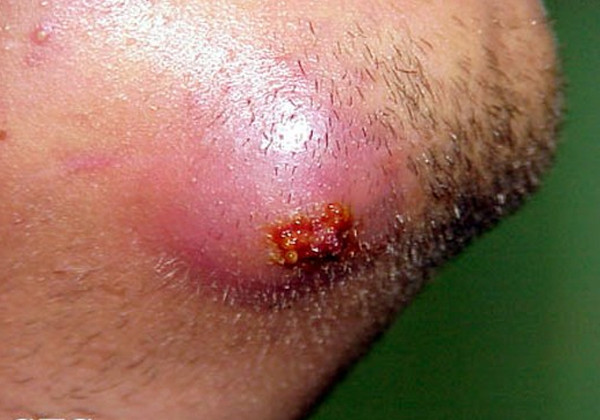
Picture 1 : Lyme disease
Image source : nlm.nih.gov

Picture 2 : Lyme disease Rash
Image source : cdn.sheknows.com

Picture 3 : Lyme disease tick and disease transmission
Image source : medicalimages.allrefer.com
Lyme Disease Treatment
Lyme disease should be diagnosed and treated right away to avoid complications. When brought to the hospital, blood works will be taken as well as medical history. The Centers for Disease Control and Prevention laid out criteria on how to confirm a disease. According to them, aside from the history of exposure to the tick, the erythema or rashes is also another way of confirming the problem. If the rashes are greater than 5 cm in size, it is a case definition. In ordinary erythema or rashes, the width is less than 5 cm.
But if the patient is brought to the hospital in the later stage wherein there is a neurologic and even rheumatologic involvement, more tests would be done like CT scans and even checking of the antibodies will be done. Blood culture to know which specific spirochete bacteria is also done.
Treating Lyme disease would include antibiotic treatment. the antibiotics can be taken orally or can be given via intravenous.
Oral antibiotics
This would include Doxycycline, amoxicillin, cefuroxime and others for 10-14 days. Doxycycline should not be taken by pregnant women because it is teratogenic or it can cause fetal problems especially when taken in the first 3 months. This is where the fetus is developing.
Intravenous antibiotics
This is ideal if the disease progresses and hospitalization is required. the antibiotic treatment can run from 14 to 28 days. patients should be aware of the side effects like diarrhea, low white blood cell count and sometimes muscle ache and fatigue.
If there are further involvements especially in the neurologic and rheumatologic area, it should also be treated.
Neurologic infections
Oral antibiotic for 30 days should be done to those patients with facial or Bell’s palsy. Paresthesia should also be treated with either intravenous antibiotic or oral antibiotic by taking doxycyline for 14 days.
Arthritis
Oral antibiotic for 30 days should be done and steroids which are intra-articular should be avoided while doing the treatment because it can lead to bacterial infection. The antibiotic treatment can be done either orally or through intravenous and the drug of choice is ceftriaxone.
Prevention is always better than cure. So when patients are treated with Lyme disease, or if they still live in grassy and woody areas, they should to the following to avoid the recurrence of the disease.
- Using of insect repellants is important. About a concentration of 10 to 30 percent is necessary. Higher the concentration, the longer the person is protected from being bitten by the ticks. Insect repellants should not be used to children below 3 years old.
- Tick-proof the yard. Clearing the bushes and leaves should be done because this is where ticks usually thrive.
- Doing the correct way of removing the tick can also be helpful. The tick should not be smashed into the skin. Instead, using tweezers and picking the tick in the head or near the mouth is the correct way. Apply antiseptic on the area to avoid infection.
- Wearing of long sleeves and pants is essential when walking in areas where tick thrives like the woods and grassy places.
References:
http://en.wikipedia.org/wiki/Lyme_disease#Cause
http://www.nlm.nih.gov/medlineplus/lymedisease.html
http://www.netdoctor.co.uk/diseases/facts/lymedisease.htm

Studies have shown Lyme can be transmitted from mother to child while the child is in the womb. There are many studies that have shown Lyme can be transmitted sexually. There are documented cased of Lyme being transmitted by other biting insects. You can have Lyme disease for decades and not know it. Often times those who have Lyme are told they are mentally ill and they try to prescribe medications for mental illness.